Parents are good at noticing the obvious things. A fever. A cough. A scraped knee after a fast afternoon at the park.
Vision is different.
Children often do not realize their sight is blurry, their eyes are not working together well, or that headaches after reading are not “normal.” They simply adapt. They sit closer to screens. They avoid books. They lose their place in class. Sometimes they work harder without knowing why.
That is one reason pediatric eye exams matter so much. A child’s vision affects learning, coordination, comfort, and confidence, and some problems are easier to treat when they are found early. The CDC notes that children’s eyes can change quickly, and both the American Academy of Ophthalmology and AAPOS distinguish routine vision screenings from a comprehensive eye examination when concerns are present.
At Smallwood Eye Associates, families in Gahanna often ask the same basic question in different ways:
Do kids need an eye exam?
When should my child have a children’s eye exam?
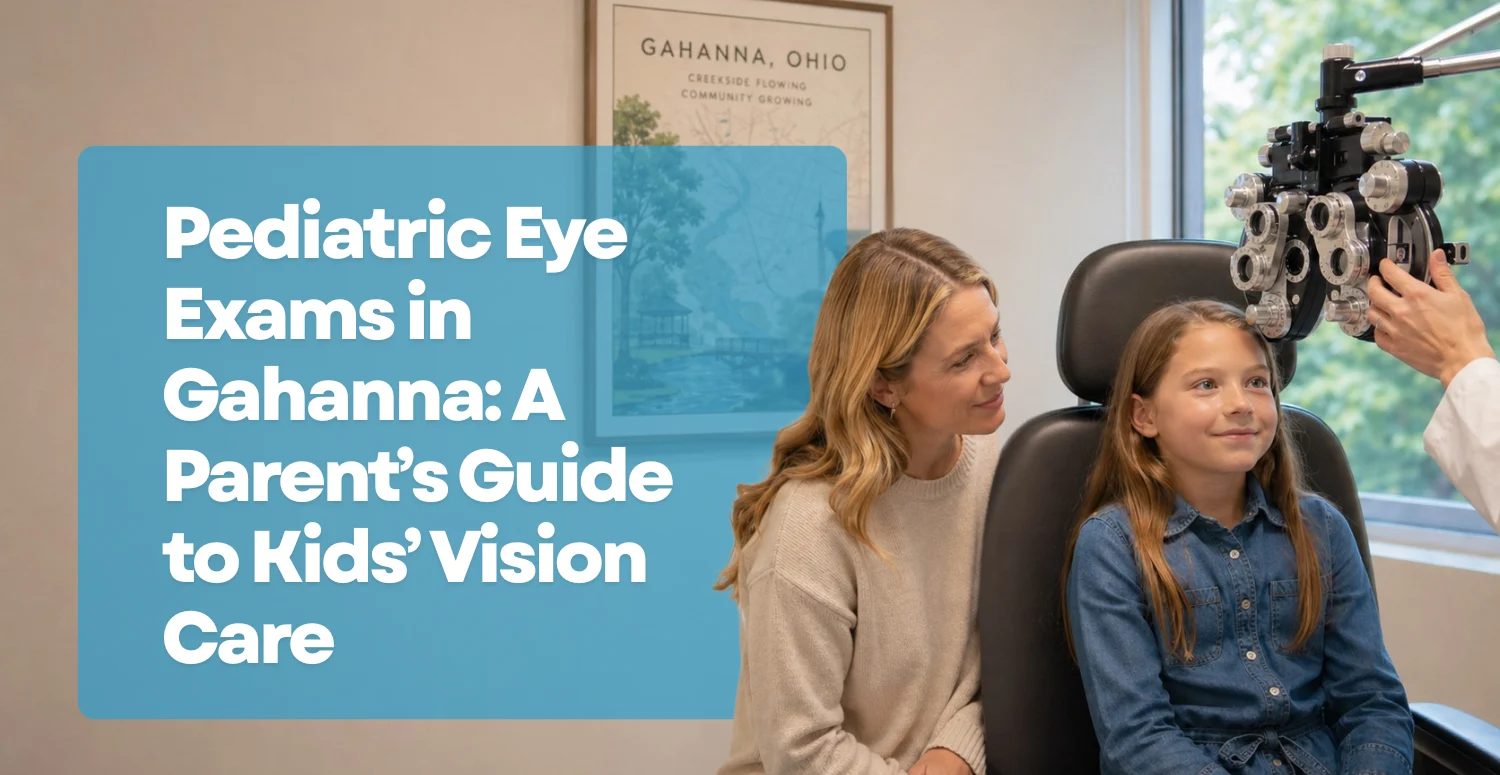
What happens during a pediatric eye exam?
They are all asking the same thing: how do I make sure my child is seeing clearly and developing well?
Why children’s eye exams matter more than many parents realize
A child does not need to complain in order to have a vision problem.
Some children with blurred vision think everyone sees that way. Others pass a school screening but still struggle with focusing, eye teaming, depth perception, or mild refractive error that becomes more obvious during reading and classroom work. A comprehensive pediatric eye exam is designed to look beyond a quick pass-or-fail check. Clinical guidance from the AOA notes that a full pediatric eye and vision exam can include visual acuity, refraction, eye alignment, eye health assessment, and other age-appropriate testing.
That matters because early childhood is when the visual system is still developing. Conditions such as amblyopia, strabismus, and significant refractive error are easier to detect and manage when they are caught on time. The AAO and AAPOS both emphasize regular childhood vision screening and referral for comprehensive evaluation when concerns are identified.
Kids eye exam, children’s eye exam, or pediatric eye exam: is there a difference?
In real life, parents use all three phrases interchangeably.
A kids eye exam, children’s eye exam, and pediatric eye exam usually mean the same thing: a comprehensive eye evaluation tailored to a child’s age, development, attention span, and symptoms.
The exact tests may vary depending on whether the child is a baby, preschooler, or school-age student. A toddler may respond to pictures, lights, and tracking targets. An older child may read letters, compare lenses, and complete more detailed testing. The goal is the same in each case: to understand how the eyes see, focus, move, and work together, and to check the health of the eyes themselves.
When should a child have an eye exam?
There is not one single rule that fits every child, but there are strong, practical guidelines.
The American Optometric Association recommends a comprehensive eye exam at about 6 to 12 months, again at least once between ages 3 and 5, and again before first grade, with additional exams as recommended based on risk or findings. The CDC also notes the USPSTF recommendation that children have at least one vision screening between ages 3 and 5 to help detect amblyopia or its risk factors.
Babies and toddlers
An early baseline can help identify eye turns, focusing problems, unusual eye movements, structural concerns, or large refractive errors. This is especially important if there is a family history of eye disease, premature birth, developmental concerns, or anything unusual about how the child tracks or uses their eyes.
Preschool years
This is a critical window. AAPOS screening guidance highlights the preschool years as an important time to detect problems related to visual acuity, alignment, and amblyopia risk.
School-age children
Once school starts, vision demands increase fast. Reading, writing, sports, digital devices, and classroom boards all place different demands on the eyes. Even children who are doing “fine” may benefit from a full exam if they have not had one recently, especially before kindergarten or when school performance changes without a clear explanation.
Signs your child may need an eye exam sooner
Some signs are obvious. Others are easy to miss.
Watch for patterns such as:
- squinting or closing one eye
- sitting too close to screens
- holding books very near the face
- frequent headaches after school or reading
- rubbing the eyes often
- covering one eye to see better
- losing place while reading
- avoiding close work
- poor depth judgment
- head tilting
- eyes that seem to drift or not line up well
These kinds of symptoms are commonly flagged by pediatric eye care sources as reasons for further evaluation.
Parents should also schedule an exam promptly if a school screening is failed, if a teacher notices reading or tracking concerns, or if there is redness, pain, unusual light sensitivity, or sudden vision change. The AAO states that a child referred from vision screening, or uncooperative on repeat screening, should be referred for a comprehensive eye evaluation.
What happens during a pediatric eye exam?
A good children’s eye exam is not just a smaller adult exam. It is adapted to the child in front of you.
A pediatric eye exam may include:
- a conversation about symptoms, school concerns, medical history, and family history
- vision testing at age-appropriate distances
- checking how the eyes move and work together
- evaluating eye alignment
- assessing focusing ability
- determining whether glasses may help
- examining eye health, sometimes with dilation when clinically appropriate
That general structure is consistent with pediatric exam guidance from the AOA and AAO.
For parents, the practical takeaway is simple: the visit is meant to be thorough, but it should also feel calm and manageable. Pediatric eye care works best when the child feels comfortable enough to participate.
Why a vision screening is not the same as a full eye exam
This point matters.
A school screening or pediatrician screening can be helpful, but it is not the same as a comprehensive eye exam. The CDC and AAO both explain that vision screenings are designed to identify children who may need more evaluation. They do not replace a full eye examination.
That difference is important because some children pass a screening and still have real visual problems. A screening may not fully assess eye health, binocular vision, focusing, or subtle prescription issues that affect reading and comfort.
So if your child is struggling even after a “passed” screening, that does not automatically close the case.
Common problems a children’s eye exam can detect
A pediatric eye exam can help detect a range of issues, including:
- nearsightedness
- farsightedness
- astigmatism
- amblyopia
- strabismus
- focusing and eye teaming problems
- some eye health concerns that may not be obvious at home
Early detection matters. The preschool years are especially important for catching amblyopia and alignment problems while treatment is more effective.
And in today’s world, one more pattern is showing up often: children who need glasses earlier than parents expect. That does not always mean something serious is wrong, but it does mean a proper exam is worth doing rather than guessing.
How pediatric eye care supports learning, comfort, and confidence
Parents often think of eye exams only when a child cannot see the board.
But vision affects more than distance clarity.
Comfort during reading, attention during homework, visual efficiency in sports, and confidence in the classroom can all be influenced by how well a child’s eyes are working. Some children are labeled distracted, clumsy, or reluctant readers before anyone checks whether seeing is part of the problem.
A proper pediatric eye exam does not solve every school issue. It does something more useful: it gives you better information. And better information leads to better decisions.
Where to schedule a pediatric eye exam in Gahanna
If you are looking for a kids eye exam in Gahanna, a children’s eye exam, or a pediatric eye exam before school starts or because something feels off, the right next step is a comprehensive visit with an eye doctor who sees children regularly.
At Smallwood Eye Associates, families from Gahanna and the surrounding area come in for pediatric vision care that is local, thorough, and centered on real-life needs. Whether the concern is blurry distance vision, reading discomfort, eye strain, or simply staying ahead of problems before they affect school, early evaluation is usually easier than waiting.
A child may not always tell you they are having trouble seeing.
Sometimes an exam tells the story first.
FAQ
1. What age should a child have their first eye exam?
Many optometric guidelines recommend a comprehensive exam around 6 to 12 months, again at least once between ages 3 and 5, and again before first grade.
2. Is a school vision screening enough?
Not always. A screening can help identify children who may need more care, but it does not replace a comprehensive eye exam.
3. What are signs my child may need an eye exam?
Common signs include squinting, headaches, sitting too close to screens, rubbing the eyes, covering one eye, losing place while reading, or complaints of blurry vision.
4. Can a child have a vision problem without noticing it?
Yes. Many children assume their vision is normal because they have never experienced anything different. That is one reason routine eye care matters.
5. What happens during a pediatric eye exam?
The visit may include medical history, vision testing, eye alignment testing, focusing assessment, refraction, and evaluation of eye health, depending on age and symptoms.
6. When should I schedule an exam sooner rather than later?
Schedule sooner if your child fails a screening, complains of blurry vision or headaches, shows an eye turn, or has pain, redness, or sudden visual changes.